FUEL for the JOURNEY Is Sustainable Aviation Fuel the Answer?

FUEL for the JOURNEY Is Sustainable Aviation Fuel the Answer?

Although affected by the pandemic, the commercial aviation industry will inevitably recover and continue to grow. At the same time, it will have to take serious steps to reduce CO2 emissions.

Sustainable Aviation Fuel (SAF) has been around for about 15 years. It was originally known as biofuel. The very first biofuel flight took place on February 1, 2008, with a three-hour flight by an Airbus A380 prototype from Filton, UK, to Toulouse, France, using a 60/40 blend of jet fuel and synthetic fuel. This was followed by some serious interest in biofuels produced from a variety of raw materials, but the financial crisis of 2009 resulted in many airlines’ giving a lower priority to reducing CO2 emissions, to focus on reducing fuel consumption to save money.

The very first biofuel flight (shown above) took place on February 1, 2008, with a three-hour flight by this  Airbus A380 prototype from Filton, UK, to Toulouse, France, using a 60/40 blend of jet fuel and synthetic fuel. Airbus image.

The very first biofuel flight (shown above) took place on February 1, 2008, with a three-hour flight by this
Airbus A380 prototype from Filton, UK, to Toulouse, France, using a 60/40 blend of jet fuel and synthetic fuel. Airbus image.

However, between 2011 and 2015, according to IATA, 22 airlines performed over 2,500 commercial passenger flights using blends of up to 50% biojet fuel from feedstock including used cooking oil, jatropha, camelina, algae and sugar cane. But some of the feedstocks for biofuel could have competed with food production (oilseed and soya beans), while the use of palm oil is criticized for causing deforestation. The result was a dropoff in research.

The world has changed significantly since then. Now, there is no alternative but to look at reducing reliance on fossil fuels and to look for cleaner alternatives. However, for all the talk of radical new propulsion systems for aviation — electric, hybrid, hydrogen — it is clear that they are unlikely to be available in the near term. In fact, IATA estimates that it will not be until 2035 that electric and/or hydrogen aircraft will be available for the regional market (50-100 seats, 30- to 90-minute flights), and an additional five years until there are hydrogen aircraft for the short-haul market (100-150 seats, 45- to 120-minute flights).

That leaves larger narrowbody and widebody aircraft reliant on conventional engine technology, with a continuing demand for jet fuel. Even though continuous development has brought some significant improvements in fuel consumption, with parallel reductions in CO2 emissions, those aircraft are used for the vast majority of current airline networks and will see a substantial increase in numbers in the future. To overcome the associated rise in CO2 emissions, the entire aviation industry, manufacturers and operators, needed to find an alternative solution. This has turned out to be sustainable aviation fuel, which offers a lifecycle carbon reduction of around 80% compared with traditional jet fuel, and is now being produced by more environmentally friendly methods than in the beginning.

The IATA estimates were part of an announcement in October 2021 of the approval of a resolution to achieve net zero carbon emissions by 2050, aligning with the Paris Agreement goal of keeping global warming below 1.5°C. With 10 billion people expected to fly in 2050, at least 1.8 gigatons of carbon must be offset in that year, while the net zero commitment implies that a cumulative total of 21.2 gigatons of carbon will be offset between now and 2050.

SAF annual production

IATA predicts that 65% of this will be abated through the use of SAF, with production steadily rising over the years (see Chart 1). The rest will come from new propulsion technology, such as hydrogen (13%), carbon capture and storage (11%), offsets (8%) and efficiency improvements (3%).

Availability

All well and good, but the limiting factor right now is availability.

Take the example of Delta, which signed an agreement in March with Colorado-based Gevo that aims for a goal of using SAF for 10% of its operations by 2030. That involves roughly 75 million gallons of SAF annually for seven years but is only anticipated to start in mid-2026. However, the airline will need to secure 400 million gallons annually by the end of 2030 to meet its 10% SAF procurement commitment, and approximately 4 billion gallons annually if it were to fly solely on SAF. However, in addition to high costs, there is limited supply — only enough SAF is available on the market currently to support one day of Delta’s operations at pre-pandemic levels.

The day before the Delta agreement, Gevo signed up with the oneworld alliance (Alaska Airlines, American Airlines, British Airways, Finnair, Japan Airlines and Qatar Airways) to supply up to 200 million gallons of SAF per year for five years. This will be used only for operations in California, including San Diego, San Francisco, San Jose and Los Angeles international airports, and will start in 2027 as three facilities are still to be built in the U.S. Midwest.

Reflecting Delta’s concerns about availability, this agreement followed another by oneworld in November 2021, with renewable fuels company Aemetis, to purchase more than 350 million gallons of blended SAF for operations at San Francisco International Airport. This is due to start in 2025 for seven years, but it has to meet current certification standards, so it will be a less sustainable blend of 60% conventional jet fuel and 40% SAF. In March, Finnair signed up for 17.5 million gallons, worth approximately $70 million over the seven- year term of the agreement. The airline has its own target to fly carbon neutral by 2045.

Gevo’s SAF, to be produced in the U.S., will use inedible corn products that will be processed to create ethanol that will then be converted into sustainable aviation fuel. The entire supply chain will be certified by the Roundtable for Sustainable Biomaterials standard, which is widely recognized as the most robust certification scheme for bioenergy.

Aemetis is building a facility in Riverbank, Calif., that will use scrap agricultural products from orchards and vineyards, combined with renewable vegetable oil and animal fats. Through gasification, the wood fibers will be distilled to create hydrogen. This is then combined with vegetable oil and animal fat to produce SAF and renewable diesel. The facility, which will be co-located with a carbon capture and storage facility, can adjust to produce either renewable diesel only or a mix of renewable diesel and up to 50% SAF.

Of course, oneworld member British Airways is part of the International Airline Group, which also has a target of 10% SAF by 2030 and is investing $400 million over the next 20 years into the development of SAF. At the end of last year, the airline signed its own multiyear agreement for SAF produced at the Phillips 66 Humber Refinery near Immingham in North Lincolnshire, UK. This has already started to be delivered to the airline via the existing pipeline infrastructure that feeds directly into UK airports.

It is an encouraging sign, but it must be regarded as something of a symbolic move. The total amount to be purchased will only be enough to reduce lifecycle CO2 emissions by about 100,000 metric tons, the equivalent of powering 700 net zero CO2 emissions flights between London and New York by Boeing 787 aircraft. The airline currently operates around 40 flights a week on this single sector, using Boeing 777s.

Another airline committing to SAF is Qantas. Its most recent investment, in March, with Aemetis, was for 35 million gallons of blended SAF to be delivered to San Francisco Airport over the seven-year term of the agreement. The value of the contract including incentives is approximately $250 million. Before that, in December 2021, Qantas signed an agreement with Air bp to purchase 10 million liters of SAF in 2022, with an option to purchase up to another 10 million liters in 2023 and 2024, representing up to 15% of the airline’s annual fuel use out of London. This will be a 50/50 blend.

Establishing Supply Chains

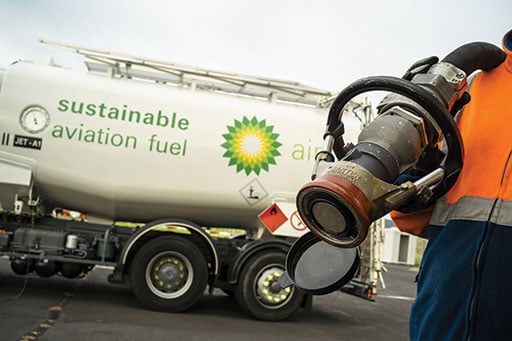
Andreea Moyes, Air bp’s global aviation sustainability director, says the company has supplied SAF to customers at over 20 locations across three continents, and it has been used to fuel many different types of aircraft, from small private jets to large passenger aircraft. It has also established supply chains across the Nordic region and supply into other areas of Europe and the U.S., which are used to meet both mandated and voluntary demand.
Air bp has established supply chains across the Nordic region and supply into other areas of Europe and the U.S. Air bp images.

Air bp has established supply chains across the Nordic region and supply into other areas of Europe and the U.S. Air bp images.

The company’s refinery in Castellon, Spain, is co-processing waste-based sustainable feedstocks with fossil fuel to produce synthetic low-carbon fuel that can be certified using International Sustainability and Carbon Certification PLUS procedures, which are approved as part of ICAO’s Carbon Offsetting and Reduction Scheme for International Aviation. This calls for at least 10% net reduction in greenhouse gases compared with conventional aviation fuel on a life cycle basis and no land use change to produce feedstock that involves land with high carbon stock (primary forests, wetlands and peatlands). Since July 2021, a major user of this fuel has been NetJets Europe, the fractional ownership operators, and it has been supplied to airports in Munich, Germany, and Biggin Hill, Bristol and Airbus-owned Hawarden in the UK.

Andreea Moyes Global Aviation Sustainability Director, Air bp

Andreea Moyes
Global Aviation Sustainability Director, Air bp

Moyes says Air bp is not standing still. In February 2022, the Lingen refinery in Germany, operated by parent company bp, produced SAF by co-processing used cooking oil with crude oil. It is also aware that much of the feedstock is from HEFA (hydrotreated esters and fatty acids). As supplies are limited, bp announced a 10-year strategic partnership in February with U.S.-based Nuseed to use carinata oil. Carinata (also known as Ethiopian mustard) is a nonfood cover crop that grows when weather limits main crop production, protects the soil between harvest and the next season’s planting, and does not compete with food production or require additional farmland. It also removes carbon from the air while growing, restoring it to the soil. The company will continue to look at new pathways. For example, in 2016, it invested in California-based Fulcrum BioEnergy, a company commercializing municipal solid waste as a feedstock.

Air bp’s latest customer is DHL Express, which recently signed another composite deal involving Finnish supplier Neste. Together, over five years, they will provide 800 million liters of SAF, split equally. Neste’s SAF is produced from sustainably sourced, 100% renewable waste and residue raw materials. With the expansion of its Singapore refinery and modification to its Rotterdam refinery, it will have an annual production capacity for SAF of 1.875 billion liters by the end of 2023. The company has been working with DHL since 2020, starting with operations from San Francisco International Airport and Amsterdam Airport. In 2021, this was extended to East Midlands airport in the UK. In its Sustainability Roadmap, parent company Deutsche Post DHL Group has committed to using 30% of SAF blending for all air transport by 2030. The combined deal means that it will exceed 50% of a separate target to reach 10% SAF blending by 2026.

OEMs Jump In

Manufacturers are also getting involved. Fourteen years after that first biofuel flight took place, the first prototype A380 took off from Toulouse on March 25 with one of its four Rolls-Royce Trent 900 engines powered by 100% SAF. As well as Rolls-Royce, Pratt & Whitney is providing support for the APU, while TotalEnergies is supplying the unblended SAF, made from HEFA, which generally consists of used cooking oil and other waste fats. That flight looked at takeoff characteristics, while another flight three days later looked at landing.

This follows an A350 flight in March 2021 as part of the Emission and Climate Impact of Alternative Fuels project (in collaboration with Rolls-Royce, German aerospace research center DLR, and oil refining company Neste) and an A319 flight in October 2021 as part of VOLCAN (VOL avec Carburants Alternatifs Nouveaux, a joint project between Airbus, Safran, Dassault Aviation, ONERA and the French Ministry of Transport).

Interestingly, that same prototype is now grounded, as it is to be converted into the ZEROe Demonstrator. This is another leap into the future, as it will become a testbed for hydrogen combustion technology, with the aim of bringing the world’s first zero-emission aircraft to market by 2035.

This is a cooperative venture with CFM, which will modify the combustor, fuel system and control system of a GE Passport turbofan to run on hydrogen. The engine, to be mounted on a pylon extended from the upper fuselage on the port side, was selected due to its physical size, advanced turbo machinery, and fuel flow capability. Caudal position, as well as a hydrogen combustion engine mounted along the rear fuselage. A distribution system will feed liquid hydrogen from four tanks in the lower rear fuselage into a conditioning system that will transform the hydrogen into gaseous form before it is introduced into the engine and combusted for propulsion. The first flight is expected to take place in the next five years.

Also in March. Pratt & Whitney successfully tested the GTF Advantage engine configuration at its facility in West Palm Beach, Fla., to validate its performance on 100% SAF in thrust transients, starting and operability, a key element to achieve EIS in 2024. The fuel used was 100% Hydroprocessed Esters and Fatty Acids-Synthetic Paraffinic Kerosine (HEFA-SPK) fuel acquired from World Energy for the test.

Of course, the GTF is one of the new generation turbofans that provided a step change in fuel consumption and emissions, reducing them by 20%. As a result, GTF engines have saved more than 2 billion liters of fuel and more than 6 million metric tons of CO2 since entering service in 2016.

The company says it has been actively involved in testing SAFs for almost two decades and helped to establish the technical standards that allow engines to operate on SAF blends of up to 50%, and is still working closely with the Commercial Aviation Alternative Fuels Initiative and ASTM International to reach 100% SAF approval. A new partner is Air bp, with an MoU to work collaboratively to explore the viable supplies of SAF up to 100% until 2024. In addition, the two companies will collaborate on researching the performance of 100% SAF to provide insights and data into fuel performance and emissions reductions.

Nearer the Destination?

It is clear from the number of events in March 2022 that the pace of SAF development is picking up. It is also clear that demand is far outstripping supply and that there are a number of possible pathways to producing the fuel. We are still some way from the day when SAF is readily available at airports around the world, and it is likely that there will be partnerships between aerospace manufacturers, airlines and fuel suppliers that will shift and move in the future.

It is also clear that the aviation industry is taking its environmental concerns seriously this time and has made a serious commitment to cleaning up its act. SAF may be a good example to use in fending off criticism and pointing the finger at other sectors, like maritime, that are more polluting and resistant to change.

DRONAMICS earn CarbonNeutral Certification on Path to Net-Zero

DRONAMICS earn CarbonNeutral Certification on Path to Net-Zero

DRONAMICS, a middle-mile cargo drone developer and operator, has achieved CarbonNeutral company certification. The certification recognizes that the company has achieved carbon neutrality in accordance with The CarbonNeutral Protocol global standard. 

As a fast-growing technology company on the path to net-zero, DRONAMICS is looking to change the status quo in the cargo mobility sector – which means doing things differently. Its proprietary Black Swan drone is powered by clean and energy efficient technologies, running at 80-100% lower emissions than other means of transportation. Furthermore, its certified engine runs on biofuels as well as synthetic fuels, generating significant carbon emission savings without the challenges of electric technology. 

Carbon neutrality is achieved by calculating a carbon footprint and reducing it to zero through a combination of in-house efficiency measures, renewable energy and external emissions reductions projects. The CarbonNeutral company certification is based on DRONAMICS’ current operations as measured across Scope 1, 2 and recommended Scope 3 emission sources. These include DRONAMICS’ own operating activities, energy use, business travel, waste disposal as well as any outsourced activities. 

While sustainability has become a buzzword for businesses, DRONAMICS’ ambition is to redefine what is possible in an industry widely regarded as environmentally unfriendly. In addition to offsetting its carbon footprint, DRONAMICS has committed to an annual footprint evaluation with CarbonNeutral parent company Natural Capital Partners, to keep it on track with its goals. 

“Achieving CarbonNeutral company certification is more than an accolade, it’s a necessity. The cargo industry has a reputation for being polluting and this is something we are looking to address through innovation. We believe we can be the most efficient mobility solution for goods – faster, cheaper and with lower emissions. Our long-term sustainability strategy will see us working with Natural Capital Partners to maintain transparency and accountability.” says Svilen Rangelov, co-Founder and CEO of DRONAMICS.

Pratt & Whitney and NAAEE Announce $250,000 in Global Environmental Education Funding

Pratt & Whitney and NAAEE Announce $250,000 in Global Environmental Education Funding

Pratt & Whitney is excited to announce the Pratt & Whitney E-STEM Awards in partnership with the North American Association for Environmental Education (NAAEE). The awards will grant a total of $250,000 USD to support innovative E-STEM education programs around the world that build the skills and capacity for students ages 11-18 to use science, technology, engineering, and mathematics to address environmental challenges. Interested nonprofits can learn more at prattwhitney.com/ESTEM. Applications will open in May 2022.

Together with NAAEE, Pratt & Whitney will be awarding nonprofit organizations that have demonstrated excellence in established E-STEM education an E-STEM Excellence Prize of up to $50,000 in three regions: Asia-Pacific (APAC); Europe, the Middle East and Africa (EMEA); and the Americas. The partnership will also offer regional E-STEM Innovation Grants of up to $15,000 to nonprofits that are interested in launching new E-STEM programs.

As a leader in developing sustainable aviation technologies, Pratt & Whitney is dedicated to helping students gain access to STEM education through an environmental lens.

“Pratt & Whitney continues to pave the future of sustainable aviation, and as part of that we recognize the need to nurture the next generation of innovative engineers and sustainability experts,” said Satheeshkumar Kumarasingam, chief transformation and strategy officer, Pratt & Whitney, and the champion of the program. “The E-STEM Awards will give more students the opportunity to tackle environmental challenges and inspire real-world solutions.”

“We’re proud to partner with Pratt & Whitney to support nonprofits working with students to solve critical environmental issues using STEM solutions,” said Judy Braus, the executive director of NAAEE. “By building on the passion of our young people, this program opens new career doors, advances STEM learning, and paves the way toward building healthier and more resilient communities.”

Pratt & Whitney is committed to ensuring that future generations of engines are ready to operate with 100% sustainable aviation fuel (SAF) to reduce dependence on fossil fuels while improving engine efficiency. The company successfully tested the GTF Advantage engine with 100% SAF in March 2022. The company is also developing a range of technologies to drive further reductions in CO2 emissions from future aircraft designs. Since entering service in 2016, the Pratt & Whitney GTF engine family has saved operators more than 600 million gallons (two billion liters) of fuel and avoided more than six million metric tonnes of CO2. 

TruWeather Solutions Forges Partnership with Iris Automation for UAS Weather-enhanced Ground-based Surveillance

TruWeather Solutions Forges Partnership with Iris Automation for UAS Weather-enhanced Ground-based Surveillance

Micro weather data and analytics firm Weather Solutions has joined forces with safety avionics pioneer Iris Automation to integrate TruWeather’s micro weather services and cost-effective weather sensors into Iris Automation’s Casia G ground-based surveillance system (GBSS). 

This meshed network will provide real-time integrated communications, collision avoidance and micro-weather data to operators.

Micro weather or low-altitude local atmospheric conditions can often substantially differ from that in higher altitudes, injecting uncertainty into the safety equation. This can significantly impact uncrewed aircraft systems (UAS) and advanced air mobility (AAM) operations and revenue.

According to an FAA-funded MIT Lincoln Lab study, currently only 3% of the U.S. has accurate surface weather and cloud ceiling report measurements. 

“This is what we refer to as a data desert,” said TruWeather CEO, Don Berchoff. “Up to 40% of crewed aviation flights that are either canceled or delayed due to weather could have flown. Even higher scrub rates will occur for UAS’ flying beyond-visual-line-of-sight, with no pilot on board to spot problems, unless the surface and low altitude weather measurement gap can be closed. The industry requires even more low altitude weather measurements to increase data fidelity and flights per airframe. Without this, uncertain micro weather and wind conditions will result in conservative business decisions. Failure to resolve this problem will result in fewer flights, disgruntled customers and significant revenue losses.”

That’s where additional weather sensors come into play. TruWeather recently turned its focus to sensor placement and density optimization to capture microscale features with rapid update, at the lowest cost possible. Incorporating weather sensors into Iris Automation’s non-radar based passive ground based system, Casia G, simply made sense for both companies.

Casia G is a ground-based detect and avoid solution, to allow operators to better detect approaching aircraft and avoid collisions. It leverages the same artificial intelligence and computer vision technology used in the company’s Casia® series of onboard integrated systems, including its 360 degree / 6-camera system, Casia X. The Casia product line provides unparalleled situational awareness for intelligent decision-making, including alerts and manual or autonomous collision avoidance.

All Casia onboard systems can detect a small general aviation aircraft at an average distance of 1.2 km with a 93.2% detection rate. Comparatively, Casia’s milliseconds reaction time exceeds that of human pilots, who take about 12.5 seconds on average to avoid collision threats.

Because Casia G is sensor agnostic, it can be easily integrated with weather sensors to add real time weather data to nodes (the UA, Casia G, the command center), in addition to its already seamless air and ground-based communications. 

“Micro weather information is critical to commercial drone operations, avoiding aborted flights and unnecessary risks and overhead in order to meet the FAA 107 weather minimums. combined with Casia G, the TruWeather solution provides up to the minute, highly localized climate information to ensure safe drone operations in one easy setup,” said Lori DeMatteis, VP of sales, marketing and customer success at Iris Automation. “This meets the FAA’s stringent requirements and offers the ability to bring together all the required data in one dashboard. This partnership will drive the expansion of BVLOS safety best practices, offering clients immediate value to ensure operational safety, and rapidly changing climate information for emergency preparedness activities, ensuring both public and personnel safety.”  

The vast deployments expected around the world with this solution will also feed continual learning and reporting improvements into TruWeather’s micro-weather products and services.

Swoop Aero Joins with ChristchurchNZ to Design Urban Networks for Drone Deliveries

Swoop Aero Joins with ChristchurchNZ to Design Urban Networks for Drone Deliveries

Swoop Aero has partnered with ChristchurchNZ’s Urban Development team to establish a network including the Aviary, Swoop Aero’s autonomous docking station for a fleet of drones. The Aviary combines landing infrastructure, charging technology, payload exchange, and a user interface in an architecturally-designed structure to seamlessly scale integrated drone logistics and make access to the skies seamless for all.

Swoop Aero integrates drone logistics into the first and last mile of the supply chain to supply chain to transform its strength and agility. Since 2017, the drone company has completed over 13,000 Beyond Visual Line of Sight (BVLOS) flights, safely delivering over 750,000 items worldwide.

In 2018, Swoop Aero became the first company globally to deliver a vaccine via a commercial drone operation in Vanuatu.  The company worked with UNICEF and the Vanuatu Government, with funding from the Australian Department of Foreign Affairs and Trade (DFAT),  to increase child immunization rates across the country, deploying bi-directional drone networks to bridge the gap in access to healthcare for remote island communities.

Swoop Aero‘s service commitment is to provide the world’s leading technology platform for sustainable and scalable drone logistics Their proven technology platform has been deployed across 3 continents including in the UK, Australia, the Democratic Republic of the Congo, Mozambique  and Malawi. Now the company is looking at bringing their experience to an urban environment.

“We have proven our capabilities in remote and rural areas,” said Swoop Aero’s CEO Eric Peck. “This partnership will develop and implement the concept of an urban drone logistics network in a modern, future-facing city bringing us closer to our goal to providing a service accessible by 100 million people in 2025”

By partnering with ChristchurchNZ, Swoop Aero is leveraging the expertise of the economic development agency’s Urban Development team to design a concept for a city-wide urban air logistics network, the first of its kind in the world making access to the skies seamless for both businesses and individuals across the city.

“This partnership is a natural fit for an urban development team within an economic development agency,” said Christchurch’s GM of Urban Development Cath Carter. “Urban development is traditionally about unlocking the economic potential of places, land and buildings. This partnership expands that ambition to urban skies.”

Rocket Lab Secures Multi-Launch Contract with HawkEye 360, Confirms First Launch Planned from Virginia

Rocket Lab Secures Multi-Launch Contract with HawkEye 360, Confirms First Launch Planned from Virginia

Rocket Lab announced it has been selected by Virginia-based HawkEye 360 to launch three Electron missions for the radio frequency geospatial analytics provider. The first of the three missions is scheduled to be Rocket Lab’s inaugural Electron mission from Launch Complex 2 on Wallops Island, Virginia, ushering in an era of Rocket Lab launches from U.S. soil from no earlier than December 2022.

The multi-launch contract with HawkEye 360 will see Rocket Lab deliver 15 satellites (five clusters) to low Earth orbit across three Electron missions anticipated between late 2022 and 2024. Rocket Lab will first deploy three HawkEye 360 satellites as part of a rideshare mission, followed by six satellites each on two dedicated Electron launches.

The first HawkEye 360 mission is scheduled to launch from Rocket Lab Launch Complex 2 at Virginia Space’s Mid-Atlantic Regional Spaceport within NASA’s Wallops Flight Facility – a dedicated pad for Electron launches developed to support missions from U.S. soil for government and commercial customers. Encouraged by NASA’s recent progress in certifying its Autonomous Flight Termination Unit (NAFTU) software, which is required to enable Electron launches from Virginia, Rocket Lab has scheduled the mission from Launch Complex 2 no earlier than December 2022. With Launch Complex 2 joining Rocket Lab’s two operational launch pads at Launch Complex 1 in Mahia NZ, Rocket Lab can provide even greater flexibility over schedule, launch frequency and launch location to its global customers. Supporting Rocket Lab’s vertical integration strategy, Rocket Lab will also supply HawkEye 360 with separation systems produced by Planetary Systems Corporation, a Maryland-based space hardware company acquired by Rocket Lab in December 2021.

“I’m thrilled to welcome HawkEye 360 onto Electron’s manifest and especially looking forward to launching our inaugural mission from Launch Complex 2 in Virginia,” said Rocket Lab founder and CEO, Peter Beck. “Operating multiple Electron pads across both hemispheres opens up incredible flexibility for our customers and delivers assured access to space, something we know is becoming increasingly critical as launch availability wanes worldwide. This contract also demonstrates continued execution on our vertical integration strategy, in this case bringing reliable launch and flight proven separation systems under one roof to streamline the integration and launch process for HawkEye 360.”

HawkEye 360 COO Rob Rainhart added, “Rocket Lab provides the flexibility we need to fill out our constellation and reach our desired orbits. Their service will drive down our revisit rates in midlatitude AOIs, bringing a higher density of data to our customers. We’re excited to be joining the inaugural launch from Virginia, as a Virginia-based company launching our satellites from our home state.”

These missions will grow HawkEye 360’s constellation of radio frequency monitoring satellites, enabling the company to better deliver precise mapping of radio frequency emissions anywhere in the world. By combining radio frequency emissions data with its analytical tools and algorithms, HawkEye 360 provides commercial and government customers with insights that have helped to detect illegal fishing, poachers in national parks, GPS radio frequency interference along international borders, and emergency beacons in crisis situations.

This agreement is the latest multi-launch contract for Rocket Lab, adding to a multi-launch contract for five dedicated Electron missions for global Internet-of-Things (IoT) connectivity provider Kinéis to be launched from 2023 onward, as well as one for three dedicated missions for Earth imaging company Synspective, the first of which was launched in February 2022.