
Article by PhysicsX
The aerospace industry has always been defined by ambition — the drive to push boundaries, conquer complexity, and redefine what’s possible in the sky and beyond. Yet even the most visionary ideas can be grounded by real-world constraints: slow simulations, siloed workflows, and the inability to fully capitalize on hard-earned knowledge. These bottlenecks don’t just delay time to market — they limit potential.
Today, a new force is catalyzing a transformation: engineering powered by artificial intelligence (AI). From real-time simulation to autonomous design intelligence, AI is augmenting human capability and redefining the blueprint for aerospace innovation.
What’s holding hardware innovation back?
Despite incredible technological advances, the aerospace sector remains encumbered by traditional engineering challenges.
Slow, expensive simulations
Traditional simulation methods like computational fluid dynamics (CFD), finite element analysis (FEA), and computational electromagnetics (CEM) are powerful, but slow and compute-intensive. Engineers are often forced to make trade-offs between simulation fidelity and speed, limiting the scope of design exploration.
Instead of testing thousands of design variations, teams may only evaluate a handful, relying heavily on intuition and past experience. This results in safe, incremental gains — rarely disruptive leaps.
Fragmented, siloed workflows
Most engineering organizations operate with disconnected toolchains and departmental silos. Design teams, simulation experts, and manufacturing engineers often use incompatible software, complicating collaboration and slowing handoffs. This fragmentation obscures how early-stage decisions impact downstream factors: cost, manufacturability, performance, and even the end-user experience.
Lost knowledge, repeated effort
Each project often starts with a clean slate, with minimal reuse of insights, data, or simulations from previous programs. Valuable knowledge is siloed, or worse, lost when people move on. This leads to repeated work and stifles organizational learning and long-term innovation potential.
AI-powered engineering: a new chapter for aerospace
Once seen as a futuristic concept, AI is now making a tangible impact across the entire aerospace product lifecycle.
Real-time physics, real-world fidelity
AI is revolutionizing simulation speed and accuracy. Machine learning (ML) models trained on high-fidelity simulation data can now predict fluid dynamics, structural stress, or thermal behavior in milliseconds instead of hours or days.
Take the collaboration between PhysicsX and Leonardo Helicopters, highlighted in General Catalyst’s 2025 report, An Ambitious Agenda for European AI: by replacing costly bespoke sensors with AI-driven virtual replicas, engineers can predict helicopter dynamics across various flight scenarios, significantly reducing certification time and cutting costs and time to market.
This seismic leap enables engineers to iterate at lightning speed, unlocking far larger design spaces and uncovering high-performance, unconventional configurations that were previously out of reach.
Intelligent, unified workflows
AI is also breaking down the barriers between disciplines. By embedding intelligence into design tools and creating integrated AI ecosystems, organizations can connect the dots across simulation, optimization, manufacturing, and even in-service performance.
This unified approach reduces manual handoffs and allows engineering teams to co-design with immediate feedback on aerodynamics, weight, manufacturability, and cost. With AI handling routine optimization tasks, engineers are free to focus on creativity, problem-solving, and innovation.
Capturing knowledge, compounding innovation
AI learns. Every project adds to a growing knowledge base that ML models can access, adapt, and build on. This enables true knowledge reuse, turning past lessons into future advantages.
Over time, AI systems become smarter, more predictive, and more valuable. Instead of reinventing the wheel, companies can scale their expertise across programs, teams, and product lines.
The expanding frontier: AI in action
Let’s explore some examples of how AI is unlocking transformative impact from design to deployment:
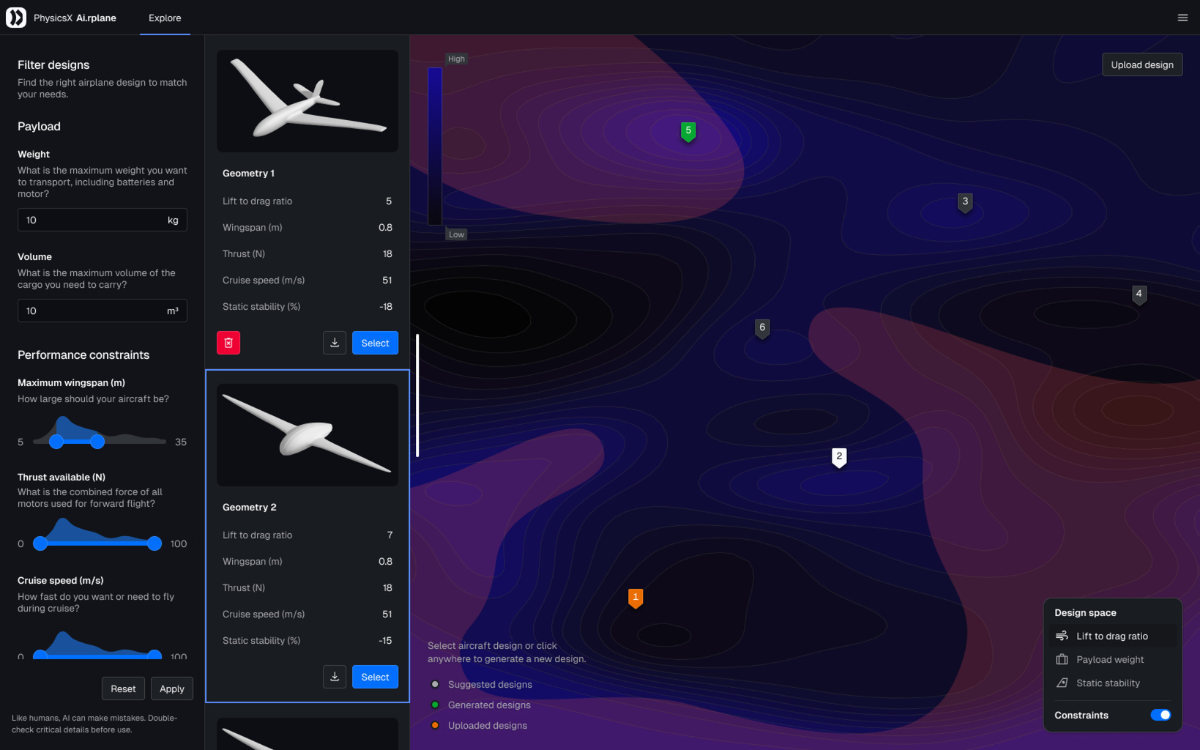
- Design exploration: At the earliest stages of product development, AI is empowering engineers to break free from traditional constraints and explore vastly broader, more complex design spaces. With deep learning models trained on historical simulation and performance data, teams can rapidly evaluate countless design alternatives, optimize geometry for performance and manufacturability, and iterate in near real-time. The result is not only faster development, but also smarter, more innovative, and production-ready designs that meet mission requirements without the bottlenecks of conventional workflows.
- Autonomous flight systems: AI-trained neural networks are powering next-gen intelligent autopilot systems, capable of handling complex flight scenarios and enabling advanced autonomy in both commercial and defense sectors.
- Predictive maintenance: By analyzing sensor data from aircraft systems, AI can identify anomalies before they become failures, reducing downtime, improving safety, and slashing maintenance costs.
- Smart manufacturing: AI-enabled quality assurance systems are making production lines more agile and accurate, adapting in real time to changing requirements and detecting defects before they hit assembly.
- Advanced air traffic management: AI is being deployed to navigate the rising complexity of modern airspace, helping optimize traffic flows in an environment crowded with drones, eVTOLs, and commercial jets.
The global market size for AI in aerospace and defense is expected to exceed USD 65.43 billion by 2034. This growth reflects a powerful shift: companies are no longer treating AI as a bolt-on feature but are embedding it into their strategies as a foundational enabler of innovation and resilience. From slashing development timelines to reducing operational risk and enabling smarter, faster decision-making, AI is driving measurable impact and reshaping the competitive landscape of the industry.
What comes next?
We are entering a new era of AI-powered engineering, where the traditional limitations of simulation speed, workflow inefficiency, and knowledge loss are no longer acceptable constraints.
Organizations that harness AI at scale won’t just design faster, they’ll design better. They’ll build digital twins that evolve in real time, simulate performance under any condition, and optimize not just for today’s needs but for tomorrow’s possibilities.
Over the next decade, we’ll see engineering teams shift from time-intensive, sequential design cycles to continuous, intelligent co-creation, where AI acts as a design partner rather than just a tool.
Conclusion
The aerospace industry has always operated at the edge of what’s possible. But with AI, that edge is getting sharper. By weaving it throughout the engineering lifecycle, organizations can accelerate iteration, enhance decision-making, and drive breakthrough innovations. Perhaps most importantly, they can capture and amplify institutional knowledge, transforming past experience into future advantage.
As airspace becomes more crowded, missions more complex, and timelines more aggressive, AI will be a key differentiator, empowering aerospace businesses to remain agile, competitive, and resilient in the face of emerging challenges.
Image: Interface of Ai.rplane — PhysicsX’s public technology demonstrator built on their latest Large Geometry Model (LGM-Aero).